


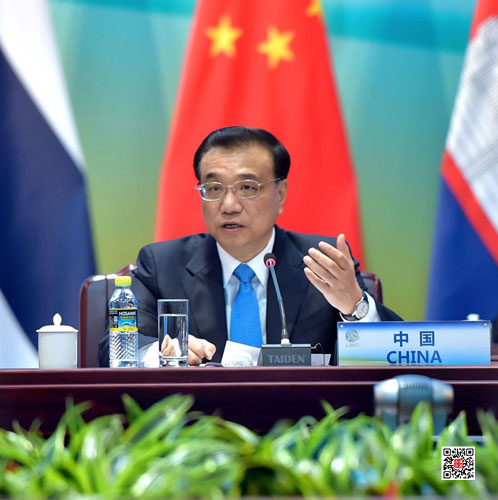
Dear Colleagues,
I am glad to meet you in Sanya, and I welcome you to the First Lancang-Mekong Cooperation Leaders' Meeting. Sanya is known for being the place where three rivers converge, and I understand that in the languages of some Mekong River countries, "Sanya" means accord or agreement. This is indeed a show of our readiness to work together for a brighter future of this region.
China and the five Mekong River countries share the same mountains and rivers. We are long-standing friends, natural partners and close neighbors. China has established comprehensive strategic partnerships with all the five countries. Our interests are closely intertwined, and our cooperation is solidly-based. In 2015, China's total trade with the five countries reached US$193.9 billion, and mutual visits exceeded 15 million. China is now the largest trading partner of Cambodia, Myanmar, Thailand and Vietnam, and it is the top investor in Cambodia, Lao PDR and Myanmar. Against this backdrop, the Lancang-Mekong cooperation mechanism has been launched to better leverage the geographical proximity, cultural affinity and economic complementarity of our six countries and generate great domestic development potential. Such a timely move will also help to inject fresh impetus to development and to betterment of people's lives in Asia as a whole.
Lancang-Mekong cooperation is forged among countries that drink the same water, water that nourishes everything without causing contention. The five Mekong River countries are important members of ASEAN, and China is a strong supporter of ASEAN integration and community-building. The Lancang-Mekong cooperation mechanism (LMC), as a useful complement to China-ASEAN cooperation, helps promote economic and social development of its members, narrow their development gaps, and upgrade overall cooperation between China and ASEAN. Lancang-Mekong cooperation is also a new practice in South-South cooperation, a concrete action that demonstrates the joint commitment of LMC countries to the United Nations 2030 Agenda for Sustainable Development.
A proverb in Southeast Asia says that when breezes combine, they will have the power of a typhoon. As the global economy experiences slow recovery and Asian economies face growing downward pressure, economic development and better livelihood for the people becomes something ever more imperative.
This meeting is convened under the theme of "shared river, shared future". We LMC countries need to jointly uphold peace, stability and tranquility in our region, and work hand in hand to pursue cooperation and development. We need to maintain the hard-won momentum of growth in our region, and build a community of shared future that features solidarity, mutual assistance, equal-footed consultation, shared benefits and win-win cooperation. This way, we will be able to ensure that in the Lancang-Mekong region, people's lives continue to improve, countries enjoy even broader prospects of development, and harmony and tranquility continue to prevail.
Stronger Lancang-Mekong cooperation and even closer ties of friendship are the common aspiration of countries and peoples in the region. In 2012, Thailand raised the idea of enhancing Lancang-Mekong sub-regional cooperation, to which China responded actively. At the 17th China-ASEAN Summit held in November 2014, I proposed establishing the Lancang-Mekong cooperation mechanism. Over the past year, we have set the framework and adopted the concept paper for cooperation. We have identified the three cooperation pillars of political and security issues, economic and sustainable development, and social, cultural and people-to-people exchanges. The five key priority areas include connectivity, production capacity, cross-border economic cooperation, water resources, agriculture and poverty reduction, and nearly 100 early harvest projects are outlined in the joint list of cooperation. This has laid a solid foundation for all-round and long-term cooperation among LMC countries.
For Asia to achieve development, there must be an environment of peace and stability. Such an environment brings benefits to Lancang-Mekong countries and provides the basis for Lancang-Mekong cooperation and development. China and the five Mekong River countries are as closely linked as lips and teeth. We enjoy the fine tradition of mutual respect, mutual trust, mutual assistance and harmonious coexistence. This puts us in a favorable position for cooperation. Good neighbors are a blessing for any country anywhere, even though they may sometimes see things differently. What we need to do is to make good use of the mature communication mechanisms, treat each other with sincerity and mutual accommodation, and consult with each other when necessary. This will enable us to deepen political mutual trust, and jointly contribute to peace and stability in the Lancang-Mekong sub-region.
It has been the fine tradition for Lancang-Mekong countries to engage in cooperation. Yet for the nascent LMC mechanism to grow strong, I believe the following four points are crucial.
-- Jointly pursue peace and stability. Peace is the foundation for development and stability the buttress for growth. Without a peaceful and stable regional environment, development and prosperity of Lancang-Mekong countries will be out of the question. Whatever changes in the international and regional situation, our six countries are always in one and the same community as forged by our common interests and shared destiny. We need to redouble our efforts and contribute even more to development and security interests of our countries and the region, and together build the solid groundwork for durable peace, stability and development in the region.
-- Give priority to development. All six LMC countries are developing countries. Hence development is of top priority. Commitment to development is especially important now given the currently sluggish world economic recovery. We need to take development as the primary goal of Lancang-Mekong cooperation and work to translate economic complementarity into real development impetus. We need to act according to the principle of equal-footed consultation, mutual learning, pragmatism, and being forward-looking, open and inclusive, and work with each other on the basis of wide consultation, joint contribution and shared benefits, so as to realize common development.
-- Focus on concrete projects. Lancang-Mekong cooperation needs to focus on concrete projects and deliver tangible benefits for the people. At present, we may, in light of conditions of every country, explore cooperation possibilities in the five priority areas of connectivity, production capacity, cross-border economic cooperation, water resources, and agriculture and poverty reduction. Our focus may be on the implementation of projects identified in the Joint List of Early Harvest Projects in order to bring our cooperation steadily forward through solid steps. I suggest that joint working groups for priority cooperation be set up as quickly as possible after this meeting to make plans for the projects and monitor cooperation progress.
-- Promote openness and inclusiveness. Lancang-Mekong cooperation, initiated by our six countries, is open and inclusive; it is not closed or exclusive. The three pillars of LMC are in line with the three pillars of ASEAN community building and will thus provide useful impetus to the ASEAN integration process. We welcome active participation and support from other ASEAN members. The LMC may well reinforce and run in parallel with GMS and other existing mechanisms. We also welcome the support of other countries both within and outside the region that all contribute to regional development and prosperity.
Dear Colleagues,
The world economy as a whole is experiencing a lackluster recovery and destabilizing factors and uncertainties are on the rise. The Asian economy is facing growing downward pressure, and China and Mekong countries have also encountered some new challenges. Yet, the momentum of development in our six countries remains to be strong. Our six countries are fortunate to enjoy the natural advantages, solid foundation, strong desire and huge potential for cooperation. The synergy we could forge through Lancang-Mekong cooperation will be much greater than the mere add-up of six individual countries. It will help us withstand outside downward pressures, promote our respective development, and open up new ways for sub-regional and regional development and revitalization. For that to happen, I wish to make the following four points for the future development of Lancang-Mekong cooperation.
First, we need to work together to build a Lancang-Mekong community of shared destiny. Our six countries are connected by the same river and the Lancang-Mekong sub-region is our common home. We need to enhance political mutual trust, increase high-level exchanges, step up governance experience sharing, and act as stronger supports of the development path each has chosen in the light of specific national conditions. Neighbors are as close as family members. We need to carefully nurture a cooperation culture distinctive of the Lancang-Mekong sub-region and build a Lancang-Mekong community of shared destiny that features solidarity, mutual assistance, equal-footed consultation, shared benefits and win-win cooperation. This will help lay a strong foundation for the fostering of an Asian community of shared destiny. I suggest the LMC leaders' meeting be held every two years to make plans and chart the course for overall LMC cooperation. The foreign ministers' meeting may be held annually and senior officials' meeting and working groups' meeting be convened as necessary to follow through on the cooperation agreement. When called for by special occasions, special leaders' meeting or special foreign ministers' meeting may also be organized on the basis of consensus. All these will help shape a cooperation structure with leaders' guidance, all-round cooperation and broad participation. This meeting will issue the Sanya Declaration of the First Lancang-Mekong Cooperation Leaders' Meeting to demonstrate our resolve to enhancing cooperation and draw the blueprint for future cooperation and development.
Second, we need to speed up connectivity and production capacity cooperation. Connectivity generates major impetus to regional cooperation. China has signed or is discussing with Mekong countries cooperation documents on jointly building the Silk Road Economic Belt and the 21st Century Maritime Silk Road. China wants to synergize its development strategy with that of countries in the sub-region. We need to expedite major projects including the China-Lao PDR railway, the China-Thailand railway, and the China-Myanmar land-water transportation facility. We may also explore the possibility of establishing border area economic zones, industrial parks, investment zones and transportation networks to improve infrastructure development in the sub-region. Now Mekong countries are at the crucial stage of industrialization and urbanization, hence the need for better infrastructure, regional connectivity, and international cooperation on production capacity. China, on its part, has many competitive industries, quality surplus capacity, and cost-effective equipment and products. We may help the Mekong countries advance industrialization and go up the value chain. This meeting will discuss and adopt the Joint Statement on Production Capacity Cooperation Among Lancang-Mekong Countries. I believe we all need to earnestly abide by the principles of the statement, leverage respective competitive edges and strengthen cooperation in such fields as infrastructure, engineering machinery, electricity, construction materials and communications. China wishes to set up a RMB10 billion yuan concessional loan and a US$10 billion credit line, including a US$5 billion preferential export buyers' credit and a US$5 billion special loan on production capacity cooperation, to support infrastructure and production capacity cooperation in the sub-region. China also will provide active support for infrastructure cooperation and development in the sub-region through such platforms as the AIIB and the Silk Road Fund. As the RMB becomes an increasingly international currency, China also wishes to step up financial cooperation with Mekong countries. The RMB is now included in the IMF SDR basket of currencies and the RMB exchange rate will remain basically stable at an adaptive and equilibrium level for the long run. This puts us in a better position to make greater use of the RMB to support sustainable development and concrete cooperation initiatives in production capacity, poverty reduction and ensuring financial stability. I also see huge room to scale up trade within the sub-region. China will further expand local currency settlement in trade and investment with Mekong countries. We may improve cross-border RMB clearance arrangement, and work for more currencies of Mekong countries to be directly quoted and traded against the RMB in the regional markets, so as to expand and upgrade trade in the Lancang-Mekong sub-region.
Third, we need to focus on sustainable development. The ultimate purpose of development is to deliver a better life for the people. This year marks the first year to implement the UN 2030 Agenda for Sustainable Development. Countries in the Lancang-Mekong sub-region are active participants in and contributors to the process. China has put forward a non-paper on LMC poverty reduction cooperation at this meeting. We will continue to implement the Cooperation Initiative on Poverty Reduction in East Asia and conduct demonstration projects of poverty alleviation cooperation in Mekong countries, who in fact could be among the first beneficiaries of the US$200 million set from the South-South cooperation fund, for better implementation of the UN 2030 Agenda for Sustainable Development. China will also set up a special fund for Lancang-Mekong cooperation and provide US$300 million in the coming five years to support small- and medium-sized cooperation projects initiated by the six countries. China wishes to set up, in collaboration with Mekong countries, a water resources cooperation center and an environmental protection cooperation center, to strengthen technical cooperation, personnel exchanges and information sharing, and promote green, coordinated and sustainable development in the sub-region. China wishes to step up joint cross-border prevention and control of epidemic diseases, train more public health professionals for the five countries and carry out the "Brightness Action" program to conduct free cataract surgeries for local patients in Mekong countries.
Fourth, we need to build bridges of people-to-people and cultural exchanges. It is the heart-to-heart exchanges that sustains true friendship. China and Mekong countries enjoy geographical proximity, cultural affinity and close people-to-people ties. The number of Chinese tourists traveling to the five Mekong countries has been growing each year to reach 12.8 million visits in 2015. China has become the largest source of tourists for Thailand and Vietnam. In recent years, young people in Mekong countries have become more enthusiastic about learning the Chinese language. In 2015, China and the five Mekong countries exchanged over 60,000 students in total. I was told that some hit TV programs in China, like A Bite of Chinese food, are also popular among Mekong River countries, as these programs provide a glimpse of the Chinese cuisine, culture and way of life of young Chinese people. Likewise, the culture and cuisine of the five Mekong countries are much sought after by the Chinese people, especially the young Chinese. This shows just how eager people are in our six countries to engage in exchanges and know more about each other. China wishes to conduct various forms of people-to-people and cultural exchanges with Mekong River countries in education, science, technology, culture, tourism and among our young people to increase friendship and mutual trust. We may also strengthen cooperation in human resources training. In the coming three years, China may provide an annual amount of 18,000 government scholarships and a total of 5,000 training opportunities in China for Mekong countries. We may even explore the possibility of opening vocational education and training centers in Mekong countries. In addition, China proposes to establish a center for comprehensive law enforcement and security cooperation in the Lancang-Mekong sub-region to conduct joint law enforcement and personnel training, so as to help foster a peaceful environment for countries in the region to pursue development and for the people to live a happier life.
In China, the just concluded annual sessions of the NPC and CPPCC adopted the Government Work Report and the Outline of the 13th Five-year Plan. China's development will be guided by the new vision of innovative, coordinated, green, open and shared development. China will continue to advance structural reform, promote economic transformation and upgrading, and vigorously develop the new economy. All these mean enormous investment opportunities for Mekong countries and other countries in Asia. China stands ready to work with countries in the sub-region to promote sound and steady development of Lancang-Mekong cooperation, achieve greater progress in China-ASEAN cooperation and make new contribution to peace, stability, prosperity and development in Asia.
Thank you very much.